

Key Takeaways
Ways to keep the trip workable:
- Reset the trip: Build around what changed, not the itinerary you had before.
- Find the friction: Notice where walking, waiting, stairs or luggage add effort.
- Add support early: Arrange help or rentals before demanding travel moments.
For the broader planning path, see Temporary Mobility Equipment for Injuries, Recovery, and Interrupted Travel Plans.
An injury days or weeks before a trip can leave you staring at an itinerary that suddenly feels built for someone else. The plans may still matter just as much, whether you are traveling for a family visit, a long-awaited getaway or an event you do not want to miss. Traveling with an injury does not automatically mean the trip is over, but the version you planned may need to change.
Once the medical questions are clear with the professional treating you, the planning becomes more practical: where can you shorten the walking, create more time, simplify transportation or arrange support? The goal is not to prove you can move through the trip exactly as before. It is to shape a trip that still lets you take part without asking your body to follow an outdated itinerary.
Can you keep travel plans after an injury?
Sometimes, yes. What remains workable depends on the injury, your clinician’s guidance, the way you are traveling and how physically demanding the itinerary is. If walking tolerance has changed, for example, the trip may need a different airport plan or a slower sightseeing day. A recent procedure, new cast, significant pain, medication change or another medical concern belongs in a direct conversation with your treating professional and, when relevant, the airline before you travel.
That leaves you with two decisions that are easier to handle separately. First, understand the medical boundaries. Then look at the itinerary through those boundaries and decide what needs to change. Keeping those questions separate can help you avoid canceling plans that could be adapted while also avoiding a schedule that asks too much of you.
Start with what changed, not what you planned months ago
Most itineraries quietly assume a certain amount of walking, standing, stair climbing, luggage handling and quick movement between stops. You may not notice those assumptions until an injury changes one of them. Suddenly, a perfectly ordinary airport connection or evening out can feel like the hardest part of the day.
Rather than reviewing the trip attraction by attraction, look at it through the effort each part requires. That shift makes it easier to see what still works, what needs support and what can simply be made easier.
Walking distance
Start with the longest stretches between transportation, lodging, restaurants and planned activities. A place that looked compact on a map may feel very different when every block takes more effort than usual. Shorter routes, closer drop-off points and reliable places to sit can preserve more energy for the parts of the day you actually came to enjoy.
Standing and waiting
The headline activity is not always the tiring part. Airport lines, attraction queues, hotel check-in and rideshare pickup can all add standing time before the day has really begun. Notice where you may be waiting without a predictable place to rest, because those moments are often easier to plan around before you arrive.
Stairs, curbs and transfers
A hotel room on an upper floor may work well if the elevator and route suit your current needs. Two steps at a restaurant entrance may create a different problem. Broad labels like “accessible” or “easy to reach” only tell you so much, so ask about the actual route you will use from arrival to entrance and beyond.
Luggage and carrying

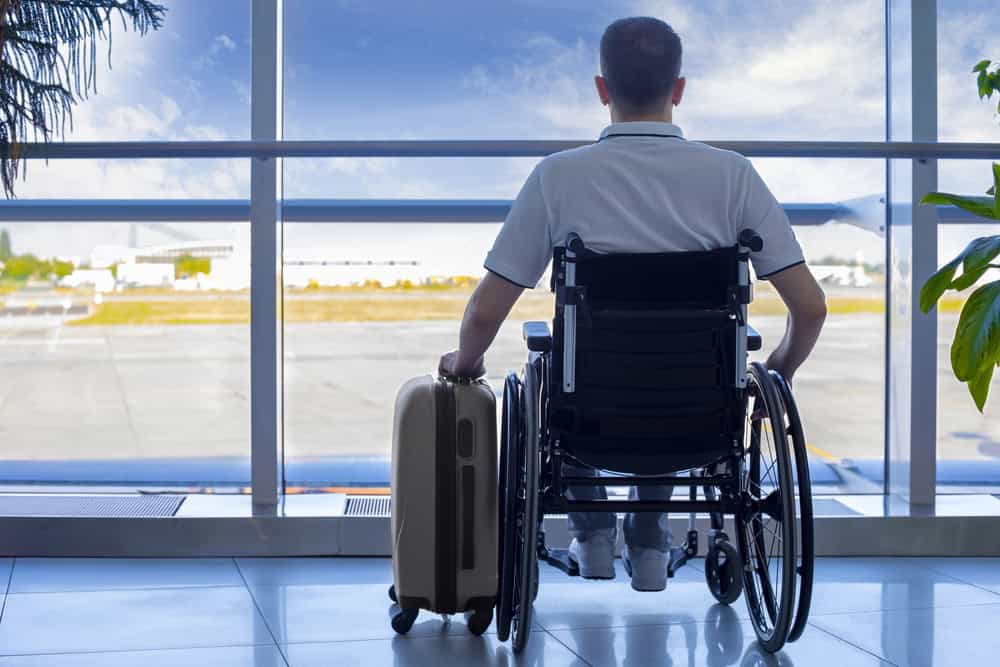
Young disabled man preparing for summer vacation.
A carry-on that barely registered before an injury can become one more thing to coordinate. Decide ahead of time who can manage bags, whether you can bring less and whether bulky equipment would be easier to arrange at the destination instead of moving it through the trip with you.
BabyQuip Insight
A good trip reset protects participation, not the original schedule. Instead of asking only, “Can I still go?” ask which parts of the day could drain the energy or coordination you want to save for being there. Once those friction points are visible, you can solve them one by one without making the injury the center of the trip.
Rebuild the itinerary around effort, not ambition
When you care about the trip, it is tempting to preserve every reservation as proof that nothing has changed. That can turn a vacation or family visit into a test. Keep the experiences that matter most, then give yourself permission to soften the parts that create the most physical friction.
Choose a few anchor experiences
Choose the experiences that would make the trip feel worthwhile even if the rest of the day became simpler. Keeping those at the center gives you room to change transportation, shorten an outing or skip an extra stop without feeling as though the day failed.
Add time between transitions
A tight itinerary leaves very little room for a slower terminal walk, a longer vehicle transfer or an accessibility issue you could not see from home. Extra time between commitments creates breathing room, so a delay in one part of the day does not have to unravel the next.
Put the hardest logistics on paper
The moments that depend on timing or help are worth getting out of your head and onto paper: airport arrival, hotel check-in, transportation to a venue, equipment delivery or a long outing. Once you can see those pressure points, you can pair each one with a person, reservation or backup plan instead of solving everything in real time.
Check transportation before you leave home
Transportation after an injury is not only about the time spent in a seat. The harder parts may come before and after the ride: getting from the curb to the gate, moving into or out of a vehicle, handling bags or covering the distance between stops. Looking at the whole transfer gives you a more realistic picture of the day.
If you are flying in the United States
U.S. Department of Transportation guidance says passengers with disabilities can request wheelchair or guided assistance for boarding, deplaning and connections. Advance notice is generally not required for many disability-related accommodations, although contacting the airline ahead can help staff prepare and some accommodations may have notice requirements. Before departure, review the DOT’s general travel tips for passengers with disabilities and confirm the details that apply with your airline.
Recent injuries can also raise airline-specific medical-clearance questions. If you have recently had a procedure, your clinician has given travel restrictions or the airline may require documentation, bring those two sources together early so you know what applies to your situation. One carrier’s process may not match another’s.
If you are driving or using ground transportation
Think beyond the ride itself and picture the entire transfer. How will you get into and out of the vehicle? Where will luggage go? Will any mobility device fit? How close can the vehicle get to your lodging or activity entrance? If someone else is driving, agreeing in advance on who handles bags and equipment can make each stop feel much less improvised.
Confirm the lodging route, not just the room
Online photos can make a room look workable while leaving out the route that may matter most. Before the trip, ask about the path from the entrance or parking area to the room, along with elevator access, stairs, bathroom layout and any doorway or space constraints that affect the support you plan to use.
Specific questions tend to produce more useful answers. Instead of stopping at “Do you have an accessible room?” ask about the feature that will shape your stay, such as a step-free route from the lobby or whether the shower requires stepping over a tub wall.
If you will use a walker, rollator, wheelchair or another device, make sure both the route and the storage space can accommodate it. Equipment can only make the trip easier when the place you are staying can work with it.
Treat help as a logistics tool, not a loss of independence
A sudden injury can make small travel tasks feel unexpectedly visible. Letting someone else carry a bag, requesting airport wheelchair assistance or arranging a ride closer to an entrance may feel like a bigger change than the task itself.
It can help to make support specific. A travel companion can handle luggage. Someone else can check the hotel route. Airport staff can provide requested mobility assistance. A rental can address one equipment need at the destination. When help is attached to a task instead of a broad idea of being “taken care of,” it can preserve more of your normal role in the trip while making the logistics easier.
Decide what support should meet you at the destination
If the trip still works but walking, standing or bathroom logistics have changed, temporary mobility equipment may solve one defined problem rather than reshape the whole experience. There is no single device for every injury or itinerary. The right category depends on your mobility needs, any clinician guidance that applies and the setting where you will actually use it.
For a short-term or destination-specific need, renting may also keep bulky equipment out of the travel day itself. If you are deciding whether that tradeoff makes sense, Temporary Mobility Equipment Rentals: When Renting Makes Sense covers that question in more depth.
If you first need a broader view of the categories that may support travel, start with mobility aids for travel.
BabyQuip’s current mobility marketplace includes categories such as wheelchairs, walking aids and bathroom aids. If your travels are taking you to major hubs like Atlanta or Chicago, you can check directly with local Quality Providers to see what mobility scooters or wheelchairs are ready for your dates. Inventory, pricing, delivery and Quality Provider availability vary by destination and dates, so live listings are the right place to see what is available for your actual trip rather than planning around a specific product too early.
Build a backup plan before the trip needs one
A backup plan is not a prediction that the trip will go badly. Think of it as a little breathing room built into the itinerary, so one unexpected problem does not force a much bigger decision.
You do not need a solution for every possible problem. You just need more than one workable path through the parts of the trip most likely to change.
Know which questions belong to your clinician
Travel planning can solve a surprising amount of friction, but it cannot answer the medical questions that are specific to your injury. Those belong with the professional who is treating you.
If you need to know whether you are fit to travel, whether flying is appropriate, how much weight you may put on an injured limb, whether swelling or pain changes the plan, how long you should use a device or when a particular activity is appropriate again, bring those questions to your treating professional. Clear guidance there gives the rest of the itinerary something solid to work around.
There is no useful travel shortcut for a question that really needs individual medical judgment. Once those boundaries are clear, you can come back to the practical work of distances, timing, transportation and support without asking a blog, rental listing or travel companion to make that decision for you.
Use this trip-reset checklist
Before you decide whether to keep, change or postpone the trip, use these questions to see where the plan still fits and where it needs a little more room.
If the trip still feels workable after you answer those questions, you have turned “I got injured, now what?” into a concrete planning conversation. For the broader recovery-and-travel path, continue to Temporary Mobility Equipment for Injuries, Recovery, and Interrupted Travel Plans.
FAQs about traveling with an injury
Should I cancel a trip after an injury?
There is no universal answer. Start with any restrictions or guidance from the professional treating you, then compare those boundaries with what the trip actually asks of you. Some itineraries may still work with less walking, different transportation or added support, while others may not fit the current medical guidance or travel requirements.
How do I know if I can fly after an injury?
Bring the medical and airline questions together. Your treating professional can address the injury-specific side, while the airline can explain its current requirements. Some recent injuries or procedures may involve medical-clearance processes, and for U.S. air travel the Department of Transportation also publishes current disability-assistance guidance for airport and airline services.
What should I change first if walking has become difficult?
Start with the longest walking segments and the places where sitting or stopping is difficult, including airports, transfers, large venues and routes between lodging and activities. Once you see those high-friction moments, you can decide whether a shorter route, different transportation, requested assistance or temporary mobility support would make the day more workable.
Can I rent mobility equipment at my destination after an injury?
In many destinations, mobility equipment can be rented for temporary needs. BabyQuip’s current marketplace includes mobility categories, while available products, prices, delivery arrangements and Quality Providers vary by location and dates. Check live availability for your destination instead of relying on a general product list.
What if I do not know which mobility device I need?
If the choice depends on medical restrictions or safe use, do not force a decision from a generic product comparison. Start with any clinician guidance you already have and name the travel problem you are trying to solve. From there, you can compare equipment categories without making the device choice carry more weight than it should.